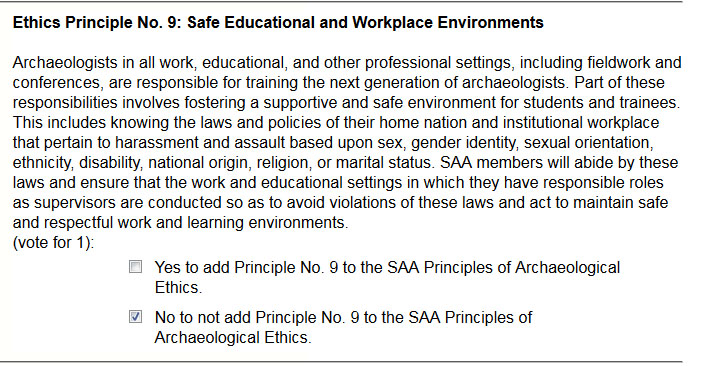
The Society for American Archaeology has an election right now on whether or not to add a ninth principle to the society's list of principles of ethics. I just voted no. Here's why.
This is the text, from the ballot site:
First, these are not archaeological principles. They do not concern sites or artifacts or fieldwork or the archaeological record.
Second, these are broader principles that affect far more than archaeology, yet they are written only for archaeology and archaeologists. In fact, their application to my lab would be discriminatory. Suppose I am nasty and I exploit students in an unsafe university lab, and I also discriminate and harass students inappropriately. If this were an official ethical principle of the SAA, it looks like my actions would be condemned for archaeology students working on one of my archaeology projects, but NOT for other students working on other projects (I also work on various projects on urbanism that are not archaeological). Or maybe I will obey the SAA and be fair and nice to my archaeology students, but I will be nasty and harassing to my non-archaeology students. Would I be violating this principle? Does the SAA want to regulate non-archaeological activities?
Third, the SAA has no enforcement procedure for its ethics principles. If I am bad and violate all these precepts, what is the SAA going to do about it? Sanction me? Sue me? Berate me in public?
Fourth, many of these actions violate my university policies and rules. If I discriminate against some students or harass others, or if my lab is truly unsafe, I can be investigated and disciplined by my university. The employer has the legal teeth to enforce these things, but the SAA does not.
The SAA should stick to archaeology. Just because these are positive principles that most of us probably agree with does not mean they should be part of the SAA's official policy.
The annual meeting of the SAA (Society for American Archaeology) just concluded in Austin, Tx. It was a fun and exhausting meeting. I was able to talk to most of the people I wanted to see, I met some interesting people, heard some good talks (and some bad talks and lots of mediocre talks). Here are a few random points:
Texas Barbecue!
I had two (count em, 2) excellent barbecue meals while in Austin. My in-laws picked me up for lunch one day, and we went to the County Line Barbecue just outside Austin. Great food, funky atmosphere, great view. Then I went to a home barbecue at the house of Michael Love and Julia Guernsey. Wow, Michael makes a mean briskit! Add beer and a bunch of interesting people, and that party was a high point of the weekend.
Boring (um, yawn, well, umph, snort, I wasn't really snoring, was I?)
Yes, there were some boring talks. Well, actually there were MANY boring talks. See my post for advice on how you too can achieve a boring result in a conference presentation! A lot of people told me that my presentations were interesting and entertaining. I do have a good style (if I do say so myself), but could that mask a lack of content? I have been tempted to give a completely vacuous presentation sometime, but with flashy powerpoints, jokes, and a lively style. Sort of like the people who submit nonsense to journals to see if they will accept the paper.
The Congress Street Bridge Bats
I did walk across the Congress Street bridge just after dusk, and I think I saw a bat! Had a nice dinner with some Mayanists at the funky Margarita Cafe, and we walked back along Congress St.
We clearly missed the dramatic flight of hundreds of bats, but I think there was one straggler flying along, plus a few drunk graduate students looking for the Penn State party (no, it wasn't under the bridge).
Risky behavior (mine)
I did admit to some potentially illicit behavior during my presentation at the Presidential opening symposium Wednesday evening. Hopefully the relevant law enforcement types didn't attend and won't come after me. This reminds me of the public admission I made in an SAA session a number of years ago. It was a session in honor of George Cowgill, and I mentioned some risky behavior I had engaged in as an undergraduate. No, I won't repeat that here. I am far too stuffy and dignified for such admissions.
Is this blog too edgy?
This seems like a pretty tame blog to me. I only say outrageous things now and then, and those things are probably not considered outrageous to anyone but a few cranky archaeologists. But today a colleague suggested that some of my posts are too edgy or over the limit. Hmmmmm. Maybe I should say something really over the top. A couple of years ago, a departmental staffer offered to send tweets when I made a post. Ok, fine. But then when I posted my advice on "how to give a bad conference talk," she decided that was too outrageous for university approval. Was I encouraging bad behavior? That's not the right signal for a university program. I guess we are supposed to be boring. That ended my free tweets from my unit (now there are new staffers, and they are tweeting my posts again, if I remember to tell them).
Suppose you take a photo of your excavation, which happens to be within a modern town, and some bystanders end up in the photo. Later you want to publish the photo in a publication of the Society for American Archaeology (SAA). Guess what? They won't let you, unless you get a signed release form from every potentially identifiable person on the image. Well, since you took the photo several years ago, you won't be able to find those people, so you can't use the photo. Even if everyone in it is an adult, behaving legally in a public setting.
Why the regressive policy by the SAA? Because perhaps someone might sue the SAA over such a photo. Not that this has ever happened, and the chances of it happening are infinitesimally small. And irrespective of whether scholarship and knowledge will be advanced by your photo.
The current issue of The SAA Archaeological Record (March 2012) discusses this issue. John C. Whittaker wrote the SAA, complaining about the policy. He is clearly outraged, and I think I share his feelings. The SAA Board of Directors reconsidered the (long-standing) policy, and decided not to make any changes. Whittaker's letter is published, as is a reply from SAA President, Fred Limp.
To me, this is just another case of the SAA putting its own financial interests above the concerns of science and scholarship, in a situation where the potential gains (to knowledge) would seem to heavily outweigh the chances of financial harm.
Maybe I'm just cranky because I am not at the SAA meetings, going on right now. Nahhhhhh. I am getting a bunch of writing done on my sabbatical, and attending the SAA would not help on this score.
The new issue of Latin American Antiquity (vol 21, no. 1, March 2010) just arrived, and it continues the pattern that ended 2009 (vol. 20, no. 4) of having NO BOOK REVIEWS. Sorry to keep harping on this; if you are interested, check out some of my previous posts on this topic:
I just got a ballot from the SAA (Society for American Archaeology) with the regular voting on committees and positions. The ballot also includes sweeping changes to the by-laws that eliminate entirely the descriptions of duties of standing committees (such as the Publications Committee). This will put much more power into the hands of the Executive Board, who would find it easier to make major changes in how the society operates. In the case of publications, this could result, for example, in a positive move toward Open Access, or it could result in retrenchment and a move away from OA (see my prior post on this). It is hard to predict the ways in which the proposed by-laws changes will be beneficial to the society, or the ways in which they may have negative consequences; it will depend on how the board uses its enhanced powers.
A more streamlined and centralized decision-making process (the stated goal of the changes) would certainly be one consequence of the proposed changes. But is this a good thing or a bad thing? I'm not sure. I have not seen any discussion of the proposed by-laws changes. The material provided with the ballot is terse and only mentions a few factors that favor the changes. Contrary views are not included. I, for one, would like to see such an important issue receive more public discussion and debate.
How would the proposed changes affect SAA publications? I have no idea, but it would be nice to see some discussion of this before making sweeping changes in the organization of the SAA. My inclination would be to vote AGAINST the by-laws changes at this point.
What would be the positive and negative impacts if the SAA were to transform its scholarly journals (American Antiquity, “AA;” and Latin American Antiquity, “LAA”) from Toll Access to Open Access (“OA”)? This entry is a thought experiment whose purpose is to stimulate thinking about OA issues. I’m sure there are relevant factors that I am unaware of or can’t think of right now.
Positive Impacts
Improved quality of articles and book reviews.
Vastly increased access to the journal.
Faster publication of articles and the reduction of backlogs.
Journal web sites.
An opportunity for journal reorganization.
1. Improved quality of articles and book reviews. One of the biggest problems with current SAA journals is the strict limit in the number of journal pages, due to costs of printing, binding, and postage. Authors are regularly asked to cut their manuscripts down—sometimes drastically—not for scientific reasons but for reasons of journal space. Now I am all for cutting the often windy prose of archaeologists (including mine), but I know that I have been forced by editors to reduce some of my LAA papers to the point where their quality was diminished, and I have heard numerous colleagues say the same thing. I have had readers ask me about cryptic statements in my LAA papers that derived directly from such cutting. OA journals do not have this kind of page limitations, so articles can be longer if they need to be. This would be an increase in quality.
The journals could also publish more book reviews! (see my previous cranky posts on book reviews). When I was Book Review Editor for JAA I was always agitating for more pages. With OA publication, editors can publish as many book reviews as they can obtain.
2. Vastly increased access to the journal. This, of course, is the main argument in favor of OA. Anyone could access the journals on line for free. Right now most of my colleagues in Mexico, for example, simply cannot get online access to any issues of LAA, one of the main journals in their discipline. If one is not affiliated with an institution with a subscription to JSTOR, then one has no access to these journals online at all. And even JSTOR is quite limiting, since the last 4 years of journals are not included.
“Public Reporting and Publication.Within a reasonable time, the knowledge archaeologists gain from investigation of the archaeological record must be presented in accessible form (through publication or other means) to as wide a range of interested publics as possible.”
Wow, this sounds like open access to me.
3. Faster publication of articles and the reduction of backlogs.Articles would appear much faster if the journals were OA, and the periodic backlogs would become a thing of the past.
4. Journal web sites. The SAA journals would have web sites! Can you imagine – these journals do not currently have web sites. Amazing. Presumably if they went OA, they would be forced to have web sites.
5. An opportunity for journal reorganization. Please see my previous post on this. Briefly, I suggested that AA and LAA redefine themselves as regional archaeology journals, and move their general papers on method and theory into a new OA journal. But if the SAA went completely OA, then all three journals would be readily available.
Negative Impacts
Loss of subscription revenue.
Potential death of the printed versions of the journals.
1. Loss of subscription revenue for the SAA. Members of the SAA would presumably remain members even if they got the journals for free. There are numerous professional reasons to belong to the society, and most members would probably continue their membership even if they didn’t get the journals. Therefore individual subscriptions would probably decline only slightly. Institutional subscriptions would be dropped, however, resulting in a significant reduction in revenue for the SAA.
2. Potential death of the printed versions of the journals. One solution to the drop in revenue from institutional subscriptions would be to discontinue the print versions of the journals. Articles would be available online, in pdf files with regular journal formatting, pagination, volumes and issues, etc. The savings from printing, binding, and mailing the journal could make up for the drop in institutional subscriptions (I have no idea of the actual figures here, and perhaps I’m way off base). Many people would be sad to see the demise of the printed journals. I know I would be sorry to see them go. I’d much rather have a paper copy of the journal in my grubby hands than just online downloadable pdf files. But what is really important for research and scholarship? A nice book-like journal you can hold in your hands, or the quality of scholarship as generated from authors, editors, and peer review? When you get right down to it, the essence of scholarly publishing is the peer review process. This would not change at all for OA. Alternatively, the SAA could decide that the continuation of the paper versions of the journals is simply worth the added expense.
So, how do the positives and negatives balance out for OA journals for the SAA? It should be pretty clear how I feel about this. What do YOU think?
NOTE: If you pay attention to the OA literature, you may notice the influence of Peter Suber’s ideas and writing in this entry.
One of my students just brought the latest issue of Latin American Antiquity (LAA) down to Mexico, and I was surprised to see NO BOOK REVIEWS. I have been dismayed at the steady decline in the number of book reviews in this journal since I stepped down as book review editor in 2002. I see this as a real crisis for New World (NW) archaeology. A number of general anthropology journals do publish reviews of books in NW archaeology, but the number they allow (or rather, the number they solicit) is very limited. In American Anthropologist, one has to wade through many more non-archaeological book reviews to find the archaeology ones (I think this is a ploy by editors to shore up the sinking notion of “4-field anthropology,” with the assumption that archaeologists will be edified by having to browse through reviews of books in linguistics or physical anthropology. But I digress). Journals like Jr. Royal Anthropological Society and Journal of Anthropological Research also publish limited numbers of reviews in NW archaeology.
But the professional archaeology journals are not publishing anywhere close to the needed numbers of book reviews. New books should be reviewed in several peer-review journals. I don’t know the situation in North American archaeology, but I hope it is far better than in Latin America. But in Latin America, there really is a crisis in book reviews. LAA is the main journal and it should be publishing fifteen to twenty reviews per issue to keep up with the new books. But it seems that recently there are two or three (and now zero !!!) reviews per issue, and often these are not the most important books. Has LAA made a decision to limit book reviews? What is going on here?
For Mesoamerican archaeology, Ancient Mesoamerica is the top journal but they do not publish book reviews. Some specialized journals (Estudios de Cultura Náhuatl or Anales de Antropología) do publish book reviews, but they are few in number. Some unrefereed newsletters (e.g., Nahua Newsletter) also have reviews, but they tend to be few in number and of uneven quality.
Perhaps my earlier complaint about the small number of good critical book reviews in NW archaeology was misplaced – it’s hard to have a lot of good reviews when books are simply not getting reviewed. Book reviews are an important part of the quality control mechanism in a field like archaeology, and NW archaeology is now suffering in this respect. I think it is a real crisis.
It was probably my worry about the sorry state of archaeology book reviews that led me to accept an offer to become a book review editor for H-Urban, a list-serve and (OPEN ACCESS) book review venue dedicated to urban history (part of the H-Net organization). As one of several book review editors, my charge is to beef up the coverage of ancient and nonwestern urbanism within H-Urban (and within urban history generally). One attraction is their insistence on rigorous peer review and the highest professional standards. If you are not familiar with H-Net book reviews (which not infrequently cover archaeological topics), you should take a look. Did I mention that their reviews are OPEN ACCESS? You can read them online from anywhere, Reykjavík to Ouagadougou, irrespective of whether you or your library subscribes to a particular journal. I’ll blog more about the H-Urban reviews in the fall, once I get up and running. But this theme covers only a small part of the production of books in New World archaeology, and it is not really a solution to the book review crisis.
NEVERTHELESS, in writing that last sentence, it occurred to me that H-Net COULD become a major venue for archaeological book reviews. It would require establishment of a new sub-list (something like “H-Archaeology”), with a moderated listserv and some dedicated book review editors. There is a level of bureaucratic organization required, with a board and moderators, by-laws, etc. The N-Net office handles all of the logistics of obtaining books and sending them to reviewers, so review editors just have to locate books, find reviewers, and do an initial edit of the reviews (alas, one the the joys of my tenure as book review editor for LAA was that I got to put my grubby paws on all the new books as soon as they were released!). The book reviews are fully equivalent to those published in journals in terms of quality, and professionalism; in fact the regulations and training for H-Urban reviews were FAR more rigorous than anything I went through for LAA. Anyway, this might provide a convenient forum, easier to establish than something like the Bryn Mawr Classical Review, an outstanding venue for book reviews and book review essays in Classics. This would also obviate the kind of battling I went through with editorial boards and the SAA for more space for book reviews.
Oh, did I mention that the book reviews on H-Net are OPEN ACCESS ? Maybe its time to free the peer-reviewed book reviews from the many limitations of the SAA (publisher of LAA) by setting up an Open Access venue, whether on H-Net or elsewhere.
I was thinking about this issue while driving through the Sonoran desert today, and I can't resist the opportunity to post from Navojoa, Sonora! When will I have another opportunity like this?
Back when I was Book Review Editor for Latin American Antiquity, the editorial board was interested in having more detailed and explicit guidelines about whether or not to publish articles that may describe or analyze looted or unprovenienced objects. The SAA (publisher of LAA) is pretty strict about this, in contrast to journals such as Mexicon, who regularly put a photograph of a pretty object from a private collection (almost certainly looted) on their cover, and who have no qualms about publishing looted objects
The LAA board asked for a volunteer to draft some guidelines on publishing questionable objects, and since I regularly teach this topic in seminars I offered to do put together the first draft. What I did was take the ideas of Alison Wylie and put them into a checklist kind of format. I submitted my draft, and the board promptly forgot all about it. But I think these issues are important and should be discussed more widely. So here are the guidelines I put together:
Notes on the publication of unprovenienced objects.
Michael E. Smith,Revised draft, 10/4/2006LAA-LootedObjects-REV.doc
These are some of the considerations that can be taken into account in evaluating whether to publish objects without secure archaeological provenience. This list supplements the SAA’s Principles of Archaeological Ethics and Editorial Policy by providing concrete examples to help editors and reviewers evaluate individual cases. They are based on the general approach to the use of questionable data described by Wylie (1995, 1996).
Under each category, options are listed in a rough rank order, from good at the top (no barriers to publishing) to bad (there should be serious reservations about publishing the object).
A. Initial Rcovery of the Object
Excavated or collected though documented legitimate archaeological methods.
Excavated or collected through poorly documented or undocumented legitimate archaeological methods.
Obtained through unknown methods.
Obtained through looting.
Obtained through illicit sale or theft from a legitimate archaeological collection.
B.Transport to Another Country
Exported with valid government permission
Permanent export permit
Temporary export permit
Exported without valid government permission:
Date of the export (in relation to laws and international conventions) ?
Exported by a scholar or official
Exported by a dealer or collector
C.Present Location
Federal or state government facility (in whatever country)
University or college
Major public museum
Small private museum (is the object likely to be deaccessioned ?)
Private collection
Commercial art dealer/gallery
D.Public Knowledge of the Object
Has been published fully
Located in a public facility
Its existence is mentioned in a publication
Never been published
Some text from Wylie 1996:179
The burden is on individual researchers “to justify their weighing of benefits and costs in quite concrete and local terms. For example, those who endorse the publication of looted data will bear the burden of demonstrating, with reference to specific contexts of practice, not only that they are operating within the law and that the data they would salvage offer insights which cannot be gained by any other means, but also that their use of these data does not, in fact, put archaeological resources at greater risk of destructive exploitation than they already face.”
Wylie, Alison
1995Archaeology and the Antiquities Market: The Use of "Looted" Data. In Ethics in American Archaeology: Challenges for the 1990s, edited by Mark J. Lynott, and Alison Wylie, pp. 17-21. Society for American Archaeology, Washington, DC.
1996Ethical Dilemmas in Archaeological Practice: Looting, Repatriation, Stewardship, and the (Trans)formation of Disciplinary Identity. Perspectives on Science 4:154-194.
There has long been uncertainty and unease about the relationship between the two scholarly journals published by the Society for American Archaeology (SAA). American Antiquity (AA) has been around for 70 years as the flagstaff journal of the society. In the 1980s there were complaints that the journal was publishing too many articles on the Maya and other Mesoamerican topics, and a new journal, Latin American Antiquity (LAA), was founded. LAA quickly developed into an important journal for archaeology in Latin America, but AA maintained its scope as both a regional journal for North America and as a general journal for archaeological method and theory. AA has always had more prestige, both because of its age and because of its role publishing papers on method and theory.
The relationship between the journals was chronicled and analyzed by Rob Rosenswig (2005), who showed a strong measure of bias. Articles on Latin American archaeology were ghettoized (my term) and papers in AA never cited them, whereas AA retained a higher status for both regional and general papers. The message to us Latin Americanists was: if you have a boring technical article, send it to LAA, but if you have something with exciting ideas on methods or theory, send it to AA.
I have a solution for the biased and imbalanced relationship among these journals. The SAA should start a new Open Access journal dedicated to archaeological method and theory. LAA can remain a regional journal on Latin America, and AA can become a regional journal on North America. The method and theory content of AA would move to the new Open Access journal. Because the new journal would be internet only, there would be no printing and mailing costs. The SAA already has a good system of copy-editing and page production, and this system could be applied to the new journal.
The advantages of OA journals are clear. (See my older posts for an intro to OA in archaeology: OA Journals and Archaeology or
The scope of SAA journals would be expanded greatly and many more readers would have access to the journal. This would improve the visibility of the SAA around the world and to other branches of archaeology and related disciplines. Open Access is clearly the wave of the future in scholarly publishing, and the SAA could help take the lead in making archaeological publishing available to a much larger audience.
The Journal of Archaeological Method and Theory is a commercial journal with good content, but it has recently become too expensive for individuals. After raising prices every year by $5 or $10, recently the costs jumped from around $60 to near $100. I’m sure that many archaeologists joined me in cancelling subscriptions. I went to the Springer website today to see what subscriptions cost now, but I could only find institutional rates! This brings to mind the old Texas saying, “If you have to ask the price, then you probably can’t afford it.” What if this journal were to morph into an SAA-sponsored Open Access journal? Springer surely would not like it, but it would benefit the discipline of archaeology and benefit individual archaeologists. Maybe I’m naïve or misinformed, but it seems to me that creative solutions like this are needed to bring archaeological publishing into the twentieth century (better journal web sites for the SAA journals wouldn't hurt either).
There are a few OA (Open Access) journals in archaeology, and these are listed in the Directory of Open Access Journals:http://www.doaj.org/doaj?func=subject&cpid=11. Two good ones that I have used are the Journal of Caribbean Archaeology: http://www.flmnh.ufl.edu/jca/default.htm, and the Bryn Mawr Classical Review:http://ccat.sas.upenn.edu/bmcr/. But the number is small, and the major journals in the field are quite restrictive in their access policies. I can download articles from back issues of many of these because my university has subscriptions, but without such an affiliation this can be difficult to impossible. Furthermore the time lag between publication and online posting affects many journals.
Journals published by commercial publishers are a real problem. Subscription costs are skyrocketing; to take just one example, the Journal of Archaeological Method and Theory just doubled in price, so I dropped my subscription. Libraries are in crisis mode over commercial journal costs. Given the economics of these journals, coupled with their efforts to restrict access to published articles (C.T. Bergstrom and Bergstrom 2006; T.C. Bergstrom 2001; Fisher 2007), I have almost decided to stop publishing in commercial journals.
Journals published by university presses are better than commercial journals in both their economics and their access policies; in these areas they are similar to journals published by many professional societies. I was initially surprised that the main societies that I belong to, the SAA (Society for American Archaeology) and the AAA (American Anthropological Association), generally oppose OA policies for their journals. For the AAA case, see discussion and links in the Open Access Anthropology Blog:http://blog.openaccessanthropology.org/. But upon reflection, this is not puzzling. These are professional societies, not scientific or intellectual societies, and their leadership does not want to sacrifice subscription revenues in the cause of broadening access to published research.
The fact that finances trump science in the SAA is clear from the Annual Meetings. For many years I have criticized the SAA (with letters to the editor in the newsletter every few years) for not being selective in accepting papers for the Annual Meeting. As a result, there are too many papers, too many simultaneous sessions, and too many boring and worthless presentations. But the SAA is unwilling to give up the registration fees of those boring presenters (who presumably won’t come if they can’t give a paper) in order to raise the intellectual level of the meeting. I was flabbergasted by a published statement by a recent SAA president that the reason the SAA didn’t review and select contributions was that archaeologists weren’t comfortable having others pass judgment on their work. Peer review, however, is a basic component of publishing, grants, and hiring in academic disciplines—including archaeology—but it is unfortunately NOT a part of the SAA annual meeting.
Archaeology, like other disciplines, clearly needs more OA journals. The basic problem is the finances. If no one pays for subscriptions, then how does one cover the costs of production? The main model right now—most prominently in the hard sciences—is for authors to pay. This may work for biochemists, who have large grants that can fund publication costs. But just trying putting such costs into your next NSF proposal and see what the reviewers say about it! This is unworkable in less lucrative fields like archaeology.
There are some reasonable funding suggestions in the OA literature, but they seem unlikely. For example, university libraries could foot the bill, using money they save when they drop expensive journal subscriptions for OA journals (I can’t see this actually happening, given the ways universities operate). Or universities could pay as part of their efforts to promote faculty activity and scholarship in general. But at my university (and many others), new academic projects and centers must be “revenue-neutral” (i.e., go find your own funding, don’t bother the Dean).
There are institutions that help in the production and operation of OA journals for relatively small fees (for example, the Scholarly Exchange:http://www.scholarlyexchange.org/), and many university libraries now help faculty who want to start OA journals by providing expertise and resources. But unless one is willing to sacrifice basic quality features of journals (such as copy-editing and professional-looking page layout), financing OA journals remains an obstacle. I have been investigating the possibility of starting an OA journal (on early states), but finances seem to be the main hurdle to work out.
Fisher, Julian H. 2007Fixing the Broken Toaster: Scholarly Publishing Re-imagined. Science and Technology Libraries. http://www.scholarlyexchange.org/openaccess.html.