Showing posts with label Ethics. Show all posts

Monday, September 19, 2016

Why I voted NO on SAA ethics principle 9

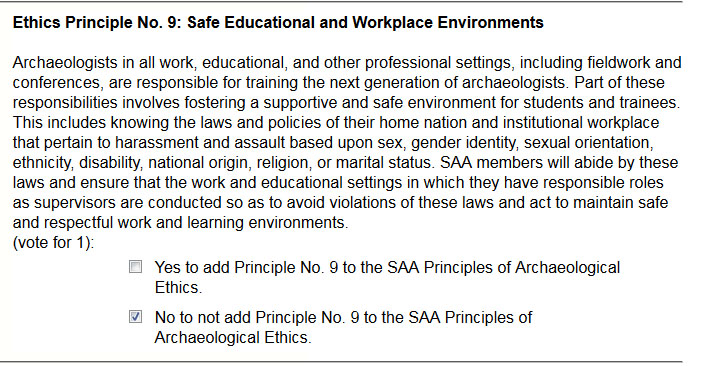
The Society for American Archaeology has an election right now on whether or not to add a ninth principle to the society's list of principles of ethics. I just voted no. Here's why.

This is the text, from the ballot site:


First, these are not archaeological principles. They do not concern sites or artifacts or fieldwork or the archaeological record.

Second, these are broader principles that affect far more than archaeology, yet they are written only for archaeology and archaeologists. In fact, their application to my lab would be discriminatory. Suppose I am nasty and I exploit students in an unsafe university lab, and I also discriminate and harass students inappropriately. If this were an official ethical principle of the SAA, it looks like my actions would be condemned for archaeology students working on one of my archaeology projects, but NOT for other students working on other projects (I also work on various projects on urbanism that are not archaeological). Or maybe I will obey the SAA and be fair and nice to my archaeology students, but I will be nasty and harassing to my non-archaeology students. Would I be violating this principle? Does the SAA want to regulate non-archaeological activities?

Third, the SAA has no enforcement procedure for its ethics principles. If I am bad and violate all these precepts, what is the SAA going to do about it? Sanction me? Sue me? Berate me in public?

Fourth, many of these actions violate my university policies and rules. If I discriminate against some students or harass others, or if my lab is truly unsafe, I can be investigated and disciplined by my university. The employer has the legal teeth to enforce these things, but the SAA does not.

The SAA should stick to archaeology. Just because these are positive principles that most of us probably agree with does not mean they should be part of the SAA's official policy.


Monday, July 13, 2015

Academia.edu takes a step backward

I have been using Academia.edu increasingly. I now post all of my current papers there, and sometimes for displacement activity I'll take a few minutes to post some older papers. There are more and more people on the service, and it has turned into a very useful resource. A few years ago I posted,   'How useful is Academia.edu?" My evaluation then was generally positive, with a few negative features. Since then, they have fixed a couple of the negative features, and others don't seem quite so serious now.

It would be useful if all academics should set up a page on Academia.edu. I always urge students to set up their own page; its a good way to become an active part of a wider professional and intellectual community, to make yourself known, and to get access to current research. I won't urge colleagues to use the service, though. Archaeologists can be rather ornery people, and in my experience if you preach to them they will either ignore you or perhaps do the opposite.

But there is one HIGHLY NEGATIVE FEATURE on Academia.edu: Linked co-authors. You post a paper, and then invite your co-authors to link to it. Then the paper is listed with the various coauthors (and their logo and links) on your page. Sounds great doesn't it? The problem is that if your co-authors are NOT members of Academia,edu, then they won't be listed! You can list them in your own custom metadata on the paper, and of course they are listed on the paper itself. But it means that the basic listing for the paper omits authors.
  • The listing is incorrect.
  • It is unscholarly.
  • It violates professional practice, and
  • It violates scholarly ethics

Consider an imaginary paper:

"The nugatory puff as a cultural imaginary" by Foucault, Derrida, and Latour.

If only two of these authors are on Academia, the paper will appear like this:

"The nugatory puff as a cultural imaginary" by Derrida and Latour

 (assuming Foucault is not a member of Academia.edu).  I don't think Foucault will be too pleased, and authors Derrida and Latour should not be happy either, to have their paper inaccurately represented. Unless they are trying deliberately to cut Foucault out of the action........

Academia has at least thought about this, and you can add a non-member as a co-author and they will automatically invite the person to join. But I am not interested in harassing my colleagues to join a service. This is what ResearchGate does, and that is the main reason I resigned from that service.

If Academia.edu is going to portray itself as a scholarly resource, then they must adhere to professional standards and ethics in the way they portray papers.

Sunday, August 3, 2014

Authorship: Who gets credit?


"Piled Higher and Deeper" by Jorge Cham
www.phdcomics.com 
Several things have gotten me thinking about issues of authorship. I've been publishing quite a bit with student co-authors lately, so this is an active topic with me and my students. In fact, authorship is most commonly a topic of concern when students are involved. Should students get authorship credit on published articles? How is this determined? Many professional societies have explicit principles and guidelines about this. The Society for American Archaeology evidently does not have any guidelines. The American Anthropological Association has a brief statement in its Code of Ethics stating that faculty should not steal data and credit from deserving students. Okay, but that is not particularly helpful.

I recently came across some personal authorship guidelines I had written up a few years ago. They correspond to my normal practice, and they agree with published discussion of this issue in the professional literature (see references below). My emphasis when I wrote these up initially was on the use of artifacts and data from my fieldwork projects, but the principles apply more widely.


(1) People who participate intensively and creatively in the research described in the work usually deserve authorship. Basic data-gathering under the direction and supervision of another does not qualify one for authorship. Thus student supervisors on an excavation typically do not qualify for authorship, whereas students or others who are involved in the design of the fieldwork and other aspects of the research may qualify for authorship. Students who apply someone else’s classification to a group of artifacts in the lab typically do not get authorship, whereas students who design and carry out a specific artifact study, establishing their own procedures, classifications, and datafiles, usually qualify for authorship. Authorship implies intellectual and practical contributions beyond simply supervising excavations or carrying out artifact classifications designed by another person.
(2) Authorship implies that each author has contributed directly to the compilation or analysis of some part of the data described in the article and/or the development of some of the ideas in the article.
(3) Authorship implies that each author has contributed directly to the writing and editing of the article (and that each has seen the final submitted version).
(4) Authorship should be discussed openly among the relevant individuals. It is best to discuss expectations and possible outcomes early in the research process, and then refine and revise the publication plans as the research and writing proceeds.
(5) The contributions of individual authors to multi-authored papers should be described explicitly and concisely in the paper (typically in the acknowledgements section or in a note).


Case study 1:  I always have a bunch of undergrads working in my lab at ASU on various research projects. Normally, they help with data collecting, data entry, and such, and thus they rarely quality for authorship on publications. But several of us did a study applying the Gini index to some central Mexican sites (it's under review right now). I had two anthropology majors gather some data, not thinking that they would end up being authors of a paper. One (Emily Colon) was asked to transcribe some documentary data to Excel so that we could analyze it. We ran into a roadblock and needed to find a way around some missing information (how do you calculate the area of a field if only a single dimension is given?). When I started to tell Emily how to proceed, I found she had already done the next step on her own, without guidance (finding relevant sources, looking for patterns, reaching a conclusion). By taking the initiative and helping devise a method to overcome the missing information, she made a creative intellectual contribution to the research, so she became an author. I asked the other undergrad, Rebecca Harkness, to look at maps of Teotihuacan apartment compounds so that we could figure out how households fit into the rooms. She went to town on this and, on her own initiative, devised a method for calculating the number of individual apartments, based on principles of space syntax. This was also a creative scientific contribution to the research, and she became another author. The other two authors are graduate students (Tim Dennehy and April Kamp-Whittaker), who made numerous contributions to the research and to the writing. I made sure each of the students wrote up their particular part of the project, so the paper is truly a joint production. We did discuss authorship openly, and we indicate in the acknowledgements who made what contribution to the paper.

Case study 2: After directing two seasons of my first post-PhD fieldwork project, I published a paper (in JFA) describing the houses we had excavated. I was feeling expansive and generous, and put all of the student excavation supervisors on the article as authors. While it made me feel warm and nice to give credit to these people who helped make the excavations a success, I probably should not have listed everyone as authors. I designed the methods, with only limited input from most of the students. After my next excavation, at Yautepec, I wrote a parallel paper on the excavated houses. This time, the paper had only three authors: me, Cindy (my wife), and Lisa Montiel. The other excavation supervisors did a good job and I have acknowledged their contributions in various ways. But Cindy and Lisa were the ones who most helped design our excavation strategy and methods, I gave them the most difficult excavations, and they helped train other students. They also contributed more than the other students to the write-up of the excavations. So they deserved authorship to a far greater degree than the other students.

Of the concerns in the scholarly publishing literature (see citations below) are the issues of "honorary authorship" (authors whose name are added to a paper, but who have not contributed directly to writing it) and "ghost authorship" (major contributors to the research and writing whose names are left off the author list). I admit I'm a bit confused about the latter practice. I guess I could write a paper with some students, and then remove my name from the published version. I take a very practical view of collaboration. If I make a major contribution to the research and writing, then I am a co-author. If a student does the work and writes the paper on his or her own, then I don't need to be an author.

One of the best sources of insight into ethical issues such as authorship is the booklet, "On Being a Scientist." If you haven't read this, you should. You can download a copy for free. Seidemann (2004) is an interesting study of authorship and other student issues in archaeology, by a legal scholar published in a law journal. It's rarely cited by archaeologists, though.

Fine, Mark A. and Lawrence A. Kurdek
1993    Reflections on Determining Authorship Credit and Authorship Order on Faculty-Student Collaborations. American Psychologist 48: 1141-1147.

National Academy of Sciences2009    On Being A Scientist: A Guide to Responsible Conduct in Research. 3rd ed. National Academy of Sciences, Washington, DC. .

Pimple, Kenneth D.
2012    Authorship in Scientific and Academic Research. CORE Issues in Professional and Research Ethics 1: Paper 4.  http://nationalethicscenter.org/content/article/176.

Seidemann, Ryan M.
2004    Authorship and Control: Ethnical and Legal Issues of Student Research in Archaeology. Albany Law Journal of Science and Technology 14: 451-496.

Seidemann, Ryan M.
2006    Authorship Credit and Ethics in Anthropology. Anthropology News 47 (1): 29-31.


Sunday, April 6, 2014

Is bad research unethical?

Suppose I were to decide to fudge some data in a publication. Maybe I refrain from reporting some

inconvenient data that don't support my argument, or perhaps I push my pet interpretation hard and don't bother to acknowledge counter-arguments or contrary data. Are these things unethical?

I refrain from this kind of activity. These activities seem deeply problematic and against my fundamental beliefs. I will usually make a stink if I catch such activities by colleagues or students. They are certainly against the standard ethical canons of science (see On Being A Scientist, something I often assign in graduate seminars). But I can't find anything suggesting they are against archaeological ethics. There is nothing in the Society for American Archaeology's Principles of Archaeological Ethics about this kind of scientific misconduct. The various collections of articles on archaeological ethics on my bookshelf don't say much about these problematic research practices. I would guess that the SAA journals would not accept papers with problematic methods like those I mention above, but the SAA style guide does not mention this at all.

This all seemed pretty normal until this afternoon. While reading up on rational choice theory, I found a reference to "post hoc theorizing" as something considered very negative in political science. Because I've been on the lookout for a concise description of what Binford called "post hoc accommodative arguments," I followed out some citations. Binford accused a lot of authors of this sin, but he never describes it in detail, or precisely what is wrong with it. I have always tried to get students to avoid this practice, but I've been looking for help from the published literature.

So I found some work on the problems of post hoc theorizing (see sources below). The main difficulty is that this practice prevents testing of one's hypothesis, since the interpretation is dreamed up after the data are gathered. It makes it difficult to know when an interpretation might be wrong. Post-hoc theorizing also opens up one's interpretations to random variation: the results are more likely to be due to chance. But then I was surprised to find these authors suggesting that this practice is also unethical.


“Graduate students in psychology are routinely taught the importance of delineating one's hypotheses in advance (i.e., prior to collecting data). Established researchers continue to regard it as questionable and possibly unethical to theorize after one's empirical results are known." (Baumeister and Leary 1997:313).

Post hoc theorizing jeopardizes the experimental method of psychology (and of much political science), and this is evidently considered an ethical lapse in that field. But I have never heard anyone suggest that the use of post hoc accommodative arguments was an ethical lapse in archaeology. Why not? I am no expert on ethics, but my guess is that the lack of a well-established methodology of data analysis in archaeology is the reason. We have canons of proper excavation technique, and if I were to screw up a dig and damage a site without proper documentation, it may violate archaeological ethics (I'm not really sure here; does incompetent excavation violate the principle of stewardship?). But my interpretation of Binford's critiques of post hoc accommodative arguments is that he was criticizing methodologically bad science, not unethical practices.

Should faulty argumentation, or other stronger cases of scientific misconduct, be considered violations of archaeological ethics? I'm not sure about this, in part because I haven't bothered to think much about it before this afternoon. But I admit that I have to admire the field of psychology if faulty experimental methods are considered an ethical breach. Perhaps archaeology needs stricter codes of ethics.

--------------------------------------------------------------
NOTE: I added this following material April 7, partly in response to Robert Mahaney's query.

Here is Kerr's (1998) list of the problems with HARKing ("Hypothesizing After the Results are Known"):

  • Translating Type I errors into hard-to-eradicate theory
  • Propounded theories that cannot (pending republication) pass Popper’s disconfirmability test.
  • Disguising pot hoc explanations as a priori explanations (when the former tend also to be more ad hoc, and consequently, less useful).
  • Not communicating valuable information about what did not work.
  • Taking unjustified statistical license.
  • Presenting an inaccurate model of science to students.
  • Encouraging “fudging” in other grey areas.
  • Making us less receptive to serendipitous findings.
  • Encouraging adoption of narrow, context-bound new theory.
  • Encouraging retention of too-broad, discomfirmable old theory.
  • Inhibiting identification of plausible alternative hypotheses.
  • Implicitly violating basic ethical principles.

 As for the ethical issue, Kerr notes that this practice is not mentioned in the codes of ethnics of the American Psychological Association, or the National Academy of Sciences. But he continues (p. 209):

·         “I think a case can be made that HARKing violates a fundamental ethical principle of science: the obligation to communicate one’s work honestly and completely. Albert Einstein states this principle well: ‘The right to search for truth implies also a duty; one must not conceal any part of what one has recognized to be true.” HARKing can entail concealment. The question then becomes whether what is concealed in HARKing can be a useful part of the ‘truth.’ ... The content of what is concealed or misrepresented in HARKing is undoubtedly less crucial than what is misrepresented when results are fabricated, but the damage done by widespread and recognized HARKing to mutual trust among scientists may be qualitatively the same.”  (p. 209)


Baumeister, Roy F and Mark R Leary  (1997)  Writing narrative literature reviews. Review of general psychology 1(3):311-320.

Green, Donald and Iam Shapiro  (1994)  Pathologies of Rational Choice Theory. Yale University Press, New Haven.

Kerr, Norbert L.  (1998)  HARKing: Hypothesizing After the Results are Known. Personality and Social Psychology Review 2(3):196-217.

Leung, Kwok  (2011)  Presenting Post Hoc Hypotheses as A Priori: Ethical and Theoretical Issues. Management and Organization Review 7(3):471-479.

Tuesday, July 9, 2013

What if you bought an artifact in a shop, and then published it as a great discovery?

The earliest bird? Or the latest looting scandal?
Does that sound bizarre and unlikely? That is what paleontologists are doing increasingly, according to a news story in a recent issue of Science ("Authenticity of China's Fabulous Fossils gets new Scrutiny," by Michael Balter, Science 340 (June 7, 2013), pp. 1153-54). A recent paper in Nature announced the discovery of Aurornis, a new species that supposedly resolves many issues about the origins of birds from dinosaurs.

*** Godefroit, Pascal, Andrea Cau, Hu Dong-Yu, Francois Escuillie, Wu Wenhao, and Gareth Dyke,  2013,  "A Jurassic avialan dinosaur from China resolves the early phylogenetic history of birds." Nature advance online publication. ***

The article itself doesn't mention exactly where the fossil was found or how it was excavated. But in the Supplemental Materials the authors admit that it was purchased from a fossil dealer. Oh, and perhaps the proposed dating is off by 35 million years because they had to guess what deposit it came from. As the supposed first bird, this unprovenienced find has made headlines around the world.
Purchased fossil featured in Nature

Evidently the use of purchased fossils has become commonplace in paleontology, to the point where there is now a craft industry in China producing fake fossils. Some scholars propose that any purchased fossil get a CT scan before being published, to prove that it is not bogus. Others think this is going too far.

I am a bit surprised that paleontologists don't seem to think this kind of thing is unethical or at all scandalous. If you transpose this situation to archaeology, it becomes an big ethical issue. Unprovenienced artifacts (frequently looted) are a real problem. Some journals will not publish them, while others do. (Smithsonian Magazine publishes looted objects.) Some archaeologists work with looted objects all the time, whereas others refuse to have anything to do with looted objects. Archaeologists have heated debates about these issues. We have ethical principles that ask us to protect the archaeological record and guard against the commercial sale of artifacts.

The Rosetta Stone
I blogged about this situation a few years ago, where I outlined a proposed scheme that journals could use to evaluate whether to publish objects of questionable provenience. I followed the lead of some papers by Alison Wylie, who writes about the trade-off between benefits to knowledge (what can we learn from the object?) and potential damage to the archaeological record (will publishing this object stimulate looting and the commercialization of the archaeological record?). In general I am firmly set against publishing artifacts that have been looted. But what if some dealer came up with the "Rosetta Stone" of Mesoamerican scripts and sold it to a collector, who offered it for study to an epigrapher? If this allowed the decipherment of, say the Zapotec script, would it be acceptable to publish the object?
Zapotec inscriptions

Wylie, Alison
1995 Archaeology and the Antiquities Market: The Use of "Looted" Data. In Ethics in American Archaeology: Challenges for the 1990s, edited by Mark J. Lynott, and Alison Wylie, pp. 17-21. Society for American Archaeology, Washington, DC.

1996 Ethical Dilemmas in Archaeological Practice: Looting, Repatriation, Stewardship, and the (Trans)formation of Disciplinary Identity. Perspectives on Science 4:154-194.


Sorry about the hiatus in posting. I am finishing up three hectic weeks of lab work in Toluca, Mexico, and madly finishing up a paper I will present in two weeks.